Water Experiences: Thesis Final Project
Bachelor of Architecture 5th Year Thesis, Fall 2013-Spring 2014
For my 5th Year Thesis, “Psychokinegraphics™: Drawing the Multisensory Experience of Movement” I developed a new language for notating and expressing time, space, movement, and the visual and non-visual affects of architecture in the scoring of user experience.
Psychokinegraphic™ Notation: I invented a pictographic language, which allows designers to notate their intentions for the non-visual, temporal and dynamic qualities of architectural spaces during the design process.
Pyschokinegraphic™ Expression: I developed an intermediate step between notation and traditional architectural drawing – the expression of the notation – literally a blown-up perspectival frame, which strives to evoke atmosphere while still representing non-visual affects through notation and symbolic use of color
Project: In the final weeks of my Thesis, I tested the Psychokinegraphic™ system in the design of a series of experiential installations in the back courtyard of the Carnegie Museum of Art in Pittsburgh, Pennsylvania, USA.
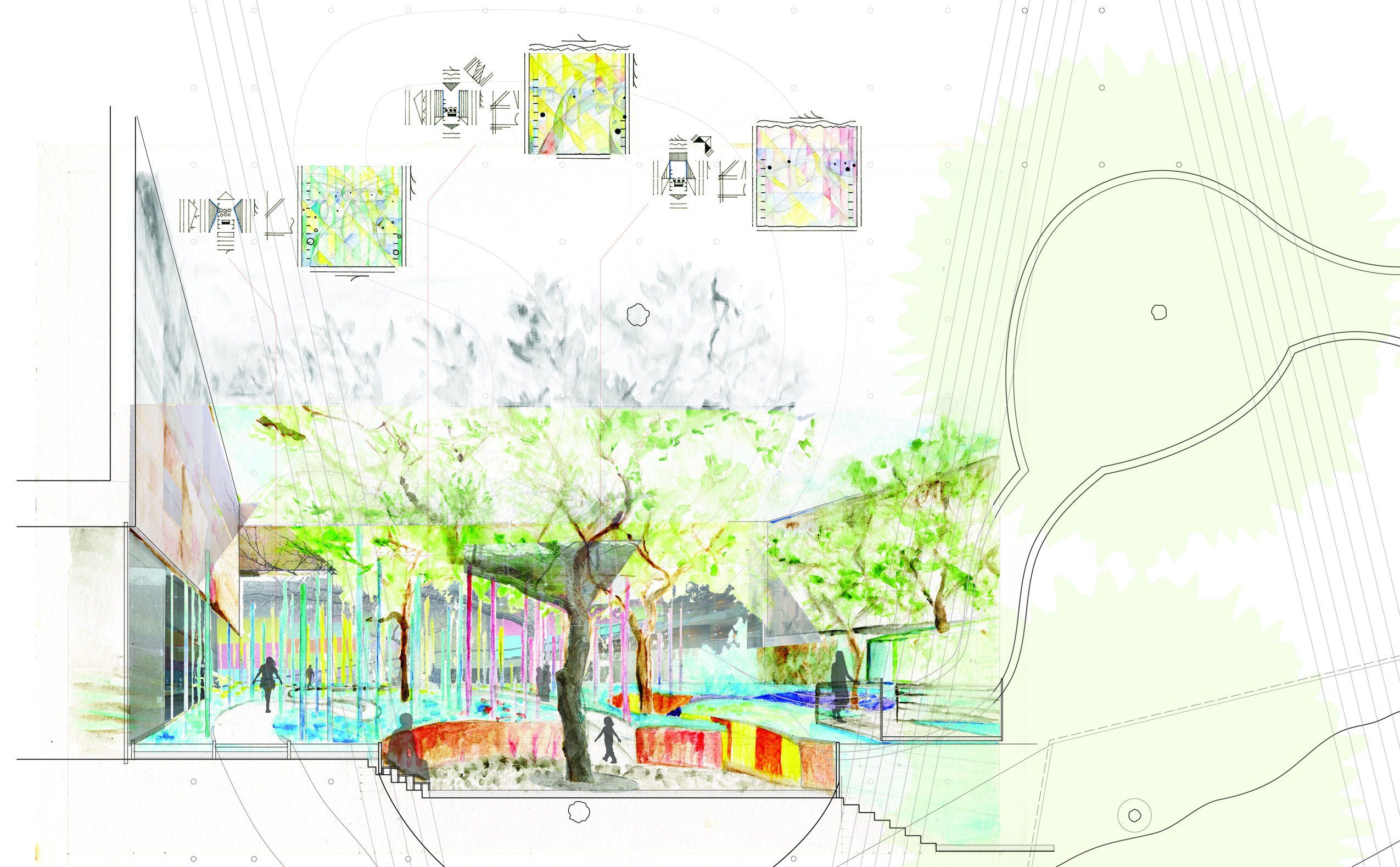
Scent Grove Presentation Drawing
The Scent Grove is about walking on the surface of the water amidst colored-glass poles releasing water of different scents. The color of the glass correlates to the different scents: green – pine, yellow – citrus, red – rose. The pathway is clear glass at exactly the level of the waters surface, giving the illusion of “walking on water.” The path gradually descends to the ground level, 3 feet below the waters surface.
In this drawing, the perspective is allowed to become dominate, with the sensory zones called out to their generative notations and expressions by dotted red lines.
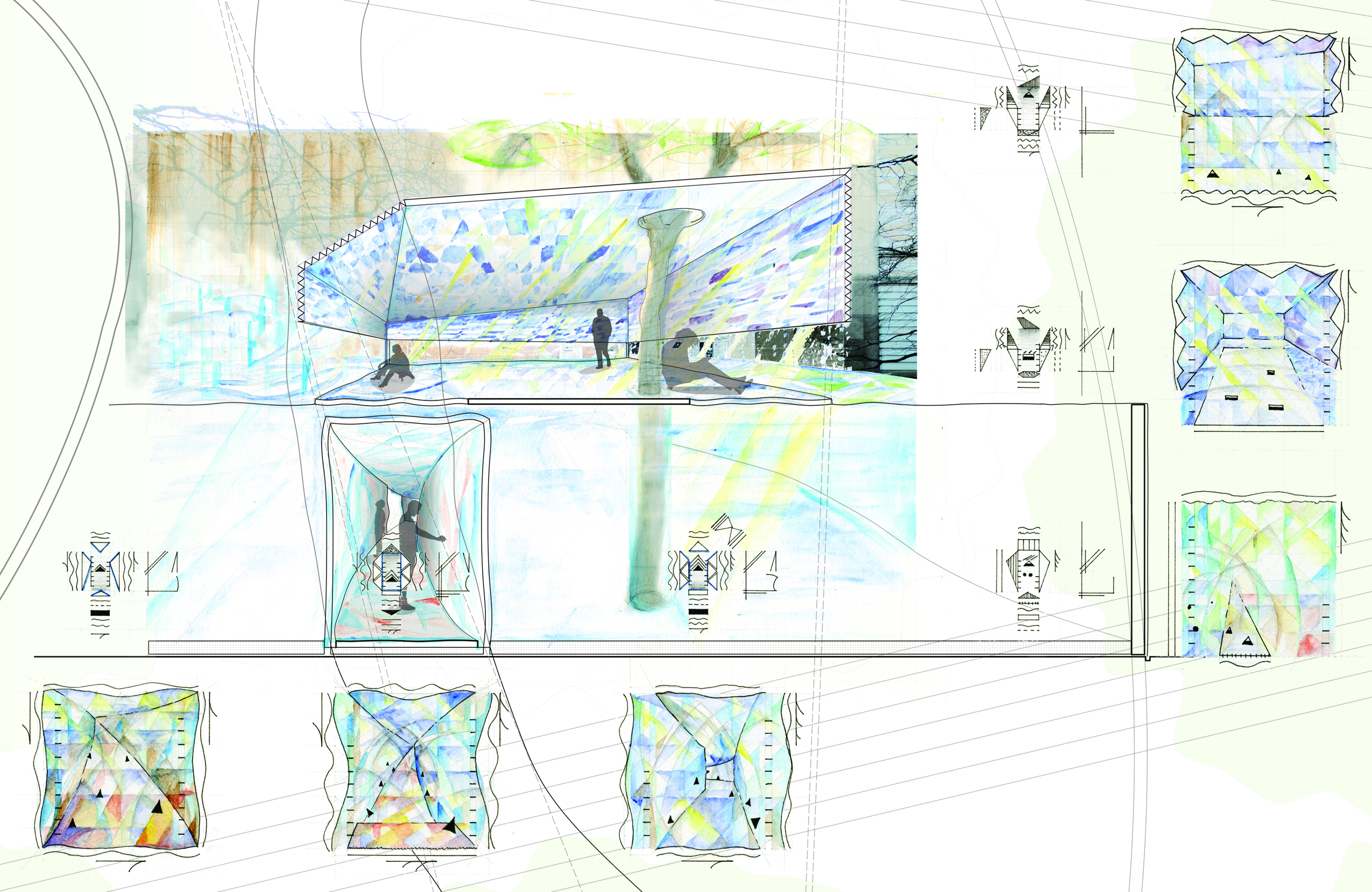
Water Tunnel + Sea Pavilion Presentation Drawing
The Water Tunnel creates the impression of walking underwater: the walls of flexible, clear plastic, enticing visitors to push the water, while 2 inches of warm water run along the ground.
The Sea Pavilion is a space of rest: the 2-foot high slot encourages visitors to sit down on inflatables at the perimeter and focus on the view of the horizon, while taking in the scent of sea-water mist and hearing droplets of water fall down the folded metal canopy. Dim light is filtered and reflected by the canopy.
This drawing shows the flexibility of arranging the notations and expressions relative to the perspective: the Water Tunnel is read left to right; the Sea Pavilion is read bottom to top.
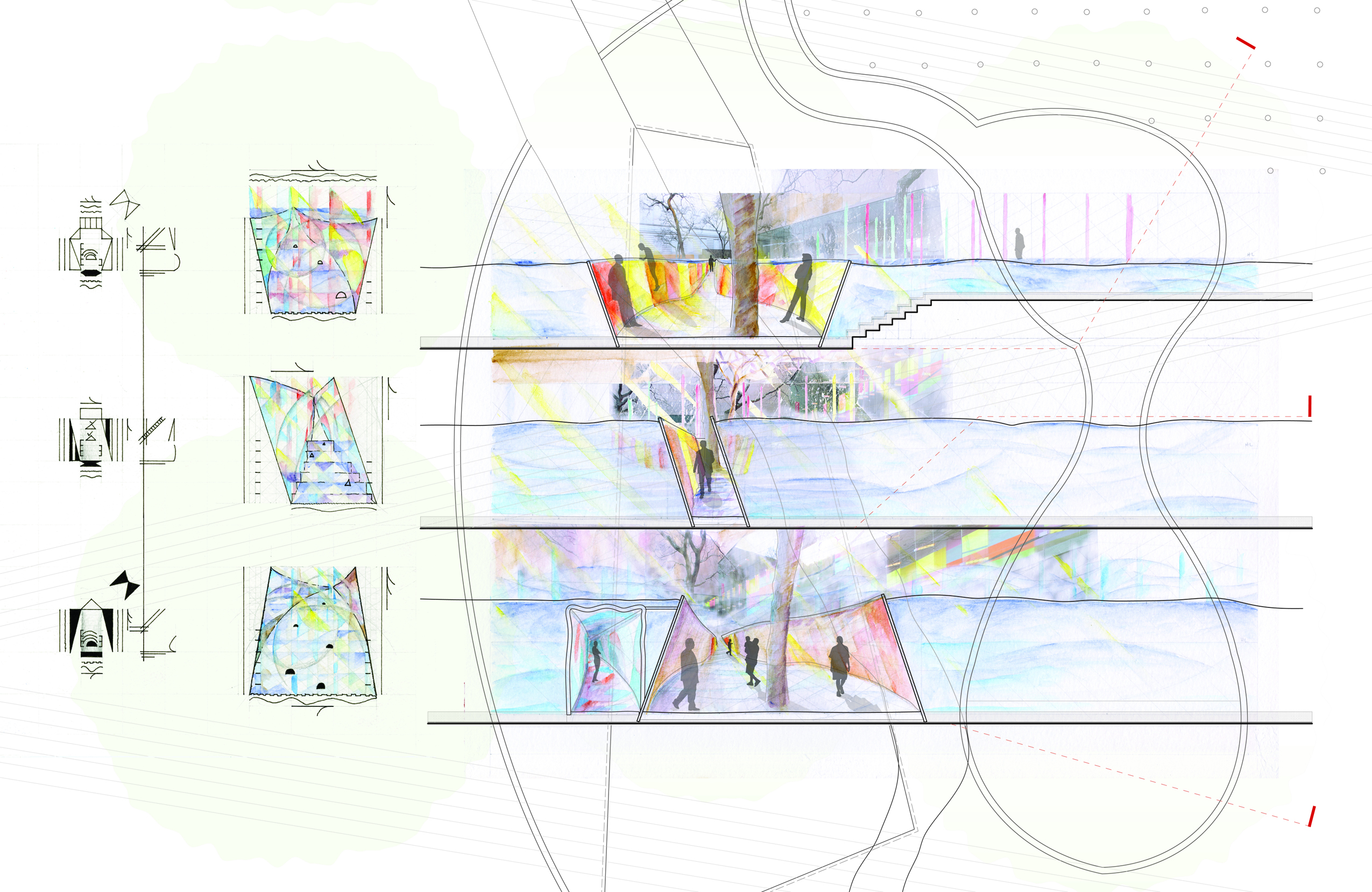
Sound Trench Presentation Drawing
The Sound Trench allows visitors to experience the water at different levels, with corresponding different sounds from the ground material. As the step on the hollow metal drum of the deepest space, the a deep sound fills the space, and focus is drawn to the sky. The walls shift angle on the stairs, where each step is a different pitched, sharper sound, and the thirds space invites visitors to lay back and take in the sun as its light filters through warm colored glass panels, just low enough for the gaze to pass over the surface of the water.
This last drawing best demonstrates the linear design process and the direct relationships between notation, expression, and projection/representation.
Copyright © 2014 Alexandre Kinney
 Alexandre Kinney